The trophy was lifted on January 18th, 2026. The champions were officially crowned on March 17th, 2026. And they were not the same team.
That is the sentence that summarizes the most bizarre, most argued-over, and most legally complicated final in the history of the Africa Cup of Nations. A match that Senegal won on the pitch, but Morocco won in the boardroom 58 days later, through a rulebook clause, a formal appeal, and a moment of collective madness that Senegal's players will spend years trying to forget.
This is the full story of what happened in Rabat and why nobody can agree on how it should end.
Two Lions, One Stage
To understand why this final hit so differently, you have to understand what was at stake for both nations heading into it.
Morocco entered the 2025 AFCON as the highest-ranked team on the African continent. Their identity as a football powerhouse had been forever cemented at the 2022 FIFA World Cup in Qatar, where they became the first African nation in history to reach the semi-finals beating Spain and Portugal along the way. Now, hosting the tournament on home soil for the first time, with 65,000 roaring fans at every match, Morocco carried the weight of a nation that had not won the AFCON since 1976. Nearly 50 years of continental hunger.
Senegal arrived as the defending African champions, having won their first-ever AFCON title in 2021. Built around one of the greatest African footballers of his generation in Sadio Mané, and supported by a core of elite European-based players, Senegal were not a team coming to participate. They were a dynasty marching toward confirmation.
When the tournament draw was made, most neutrals circled Morocco vs. Senegal as the final they wanted to see. What nobody could have predicted was the manner in which it would unfold.
The Road to the Final
Morocco: Loud and Dominant
Morocco's path through the tournament was everything their home support had demanded — clinical, relentless, and played in front of a wall of noise.
They opened the group stage on December 21st with a composed 2-0 victory over Comoros, goals from Real Madrid midfielder Brahim Diaz and Olympiacos forward Ayoub El Kaabi setting the tone immediately. A 1-1 draw against Mali on Christmas Day introduced a flicker of doubt Diaz converted a penalty, only for Mali to equalize from the spot in the 64th minute but Morocco closed out the group with a dominant 3-0 win over Zambia, El Kaabi grabbing a brace and seven points secured.
The knockout rounds brought tougher examinations. A narrow 1-0 win over Tanzania in the Round of 16 Diaz again the difference-maker was followed by a quarter-final victory. Then came the semi-final against Nigeria on January 14th: 120 exhausting, goalless minutes settled only by a penalty shootout in which goalkeeper Yassine Bounou saved two spot-kicks. Youssef En-Nesyri coolly dispatched the decisive penalty. Morocco were in their home final.
Senegal: Quiet, Lethal, Inevitable
While Morocco were theatrical, Senegal were efficient — and every bit as dangerous.
Topping Group D on goal difference, the Lions of Teranga posted a 3-0 win over Botswana two goals from Chelsea's Nicolas Jackson followed by a 1-1 draw with DR Congo and another 3-0 victory over Benin. In the Round of 16, they came from behind against Sudan to win 3-1, with Pape Gueye scoring twice before half-time. A quarter-final against Mali ended 1-0, an Iliman Ndiaye goal and a red card for Malian midfielder Yves Bissouma doing the damage.
Then came a semi-final that had the continent holding its breath: Senegal against Egypt. A rematch of the 2021 AFCON final. At the centre of it, the great subplot of modern African football former Liverpool teammates Sadio Mané and Mohamed Salah, now on opposite sides of the continental stage. It was Mané who had the final word. At 33 years old, still hunting glory at Al-Nassr, he scored in the 78th minute to send Senegal through.
Two lions. One final. Rabat.
The Match: When Chaos Became History
A Stage Set for Drama
January 18th, 2026. The Prince Moulay Abdellah Stadium. 68,000 fans packed inside and millions watching around the world. And from the first whistle, the conditions signaled this would be no ordinary final.
Heavy rain had been falling all evening. The pitch was saturated, the ball slick and unpredictable. For Senegal's veteran goalkeeper Édouard Mendy one of the most decorated shot-stoppers in African football this created an immediate and specific problem. Wet goalkeeping gloves are treacherous. A goalkeeper who cannot grip the ball is a goalkeeper undone.
Mendy's solution was a small face towel draped over his goalpost. Routine. The kind of thing goalkeepers do in wet conditions everywhere.
What followed was anything but routine.
Towel-Gate: The Incident That Went Global
In what became one of the most surreal and unsporting incidents ever witnessed at a major final, Moroccan ball boys, stadium personnel, and senior professional players engaged in a coordinated, sustained effort to steal Mendy's towels.
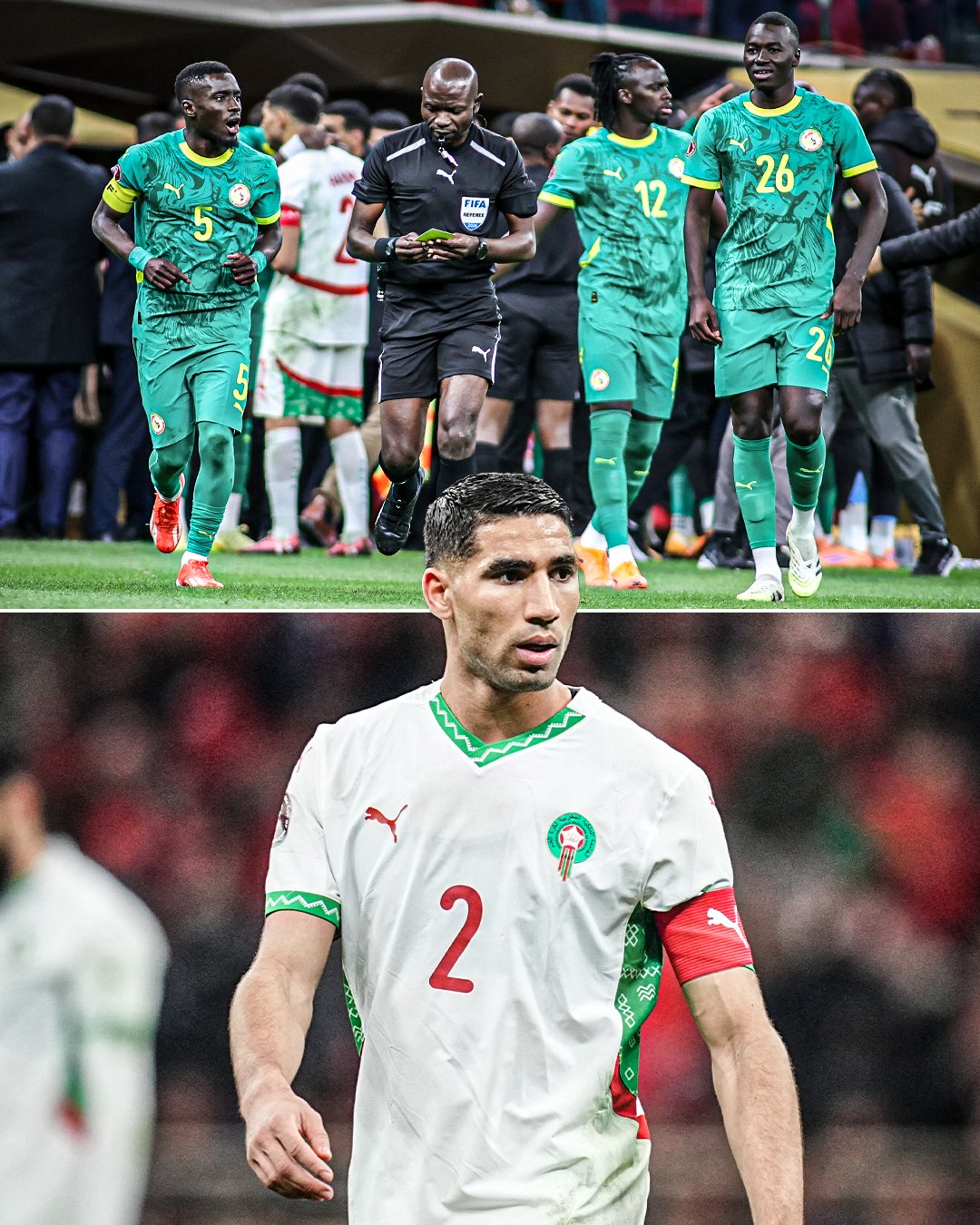
The footage was extraordinary. Paris Saint-Germain superstar and Morocco captain Achraf Hakimi a Champions League winner and one of the best full-backs in world football was caught on camera physically removing a towel from Mendy's goalpost and hurling it over the advertising hoardings. Senegal's response was to deploy their own player, Yéhvann Diouf, to stand guard at the post and protect the towel from further interference.
A professional footballer. Guarding a towel. At an AFCON final. From ball boys.
Whether the motivation was superstition a belief that the towel carried spiritual significance or pure calculated gamesmanship to disrupt Mendy's rhythm in a wet match, former Morocco manager Hervé Renard later offered the most candid take of anyone involved: "The towel story is long and complicated. In Europe, people don't understand that there is something behind it. In Africa, these beliefs exist, and everyone is free to believe what they want."
The world debated it for days. But the match, somehow, was still goalless.
Two Decisions That Broke the Match Apart
Deep into stoppage time, two refereeing calls in the space of six minutes pushed Senegal past the point of rational restraint.
92nd minute. Ismaila Sarr bundled the ball over the Morocco goal line. The Senegalese bench erupted, staff and substitutes flooding onto the sodden pitch. Then the whistle already blown. Referee Jean-Jacques Ndala Ngambo had called a foul moments earlier, ruling that Senegalese defender Abdoulaye Seck had placed two hands on Hakimi's chest. The contact that countless replays showed to be minimal at best had ended the play before the ball crossed the line. With the whistle blown prior to the goal, VAR had no jurisdiction to intervene. The goal did not stand. For Senegal, the injustice was overwhelming.
98th minute. A ball played into the Senegalese penalty area. Morocco's Brahim Diaz went to ground under a challenge from West Ham United defender El Hadji Malick Diouf. Ndala Ngambo waved play on then was called to the pitchside monitor by VAR officials, who had flagged a marginal tug on Diaz's shoulder in slow motion. After reviewing the footage, the referee reversed his original decision and pointed to the penalty spot.
The fury from Senegal's players was immediate. Surrounding the referee, shoving, protesting. And then head coach Pape Thiaw gave the instruction that would define the rest of the story: he told his players to walk off the pitch.
The Walkout
For somewhere between 15 and 20 agonizing minutes, the Africa Cup of Nations final sat in a state of total suspension. The referee stood alone on the waterlogged turf, powerless. The stadium fell into a disbelieving silence. Across the world, millions of viewers stared at their screens unsure whether the tournament was simply over.
Then one man walked down the tunnel.
Sadio Mané. Two-time African Footballer of the Year. The man who had carried this squad to back-to-back AFCON finals. He went into the dressing room and, by all accounts, told his teammates plainly: "We will play like men."
The door opened. The Lions of Teranga returned.
Upon their comeback, Mendy was issued a yellow card for the delay. And then Brahim Diaz stepped up to take the penalty that would surely deliver Morocco their first AFCON title in half a century.
He chose to do a Panenka a chipped, audacious attempt straight down the middle.
It sailed gently into the arms of Édouard Mendy. The goalkeeper barely had to move. He caught the ball as comfortably as a man collecting post from his front door.
Silence. The match went to extra time.
The Goal That Made History
In the 94th minute of extra time, Pape Gueye received the ball, drove forward from just inside the penalty area, and from slightly left of centre unleashed a thunderous left-footed strike that flew into the top-right corner.
1-0 to Senegal.
It was the first goal Morocco had conceded in open play in the entire tournament. The final whistle followed and the scenes were of pure contrast Senegalese players sprinting in every direction with arms raised, Moroccan players lying collapsed on the turf in silence.
The AFCON trophy was presented to Senegal captain Kalidou Koulibaly by CAF President Patrice Motsepe, FIFA President Gianni Infantino, and Prince Moulay Rachid of Morocco. Sadio Mané called it the greatest night of his life. Dakar erupted. The Lions of Teranga had endured towel theft, a disallowed winner, a 15-minute walkout, a missed Panenka, and 120 brutal minutes and still came out on top.
Or so everyone thought.
The Boardroom Reversal
Morocco's Legal Strategy
Even as the celebrations continued, the Royal Moroccan Football Federation had already begun preparing their formal appeal to the Confederation of African Football and their approach was precise, cold, and deliberately stripped of any sporting emotion.
The federation explicitly stated that their complaint was never intended to contest the performance of either team on the pitch. They did not challenge the disallowed goal, the VAR penalty, or Diaz's missed Panenka. They ignored the football entirely. Instead, they pointed a single blinding spotlight at the 15-to-20-minute window in which the Senegalese team abandoned the field of play without the authorisation of the referee and cited two specific articles of the AFCON competition regulations to argue that this act carried automatic and irreversible consequences.
The Articles That Changed Everything
Article 82 of the CAF AFCON Regulations states clearly:
"If, for any reason whatsoever, a team withdraws from the competition or does not report for a match, or refuses to play or leaves the ground before the regular end of the match without the authorisation of the referee, it shall be considered the loser and shall be eliminated for good from the current competition."
Article 84 provides the mechanism: the result at the time of the interruption is recorded, and the offending team is declared the loser.
When Senegal walked off at the 98th minute with the score at 0-0 and the penalty yet to be taken they technically left the ground before the regular end of the match without referee authorisation. Morocco's federation argued that this was not merely a delay of game or an emotional act of dissent. It was, by the strict letter of the law, a forfeit.
Fines, Bans, and an Apology
CAF's disciplinary proceedings distributed punishment on both sides.
Senegal coach Pape Thiaw received a five-match ban and a fine for conduct deemed incompatible with the principles of fair play and integrity. Players Iliman Ndiaye and Ismaila Sarr also received suspensions. The Senegalese Football Federation was fined $615,000.
Morocco were not spared. Ismaël Saibari received a two-match ban and a $100,000 fine for his role in the towel incidents, with Achraf Hakimi also suspended. In a gesture that stood apart from the legal proceedings, Saibari personally traveled to the Senegalese team hotel to apologize to Édouard Mendy.
The Verdict: 58 Days Later
On Tuesday, March 17th, 2026 exactly 58 days after the final whistle blew in the Rabat rain the CAF Appeals Board released its ruling.
The initial disciplinary decision, which had left Senegal's 1-0 victory intact, was completely overturned. The Appeals Board declared Morocco's appeal admissible and upheld it in full. In a brief press release, they announced that in application of Article 84, Senegal were declared to have forfeited the final — and the official result was recorded as a 3-0 victory to Morocco.
Morocco were handed the title despite also being fined $160,000 for their failure to control the stadium environment: $50,000 for the ball boy behavior during Towel-Gate, and $100,000 for player interference in the VAR review zone.
None of that mattered in Rabat. Morocco were champions. After 50 years. And it happened in a boardroom, not on a pitch.
So Who Actually Won?
That is the question this story refuses to answer cleanly — and perhaps that is the point.
On the pitch, on the night, Senegal were the better team. They absorbed the chaos, survived the controversy, walked back from the brink of forfeiture, and scored the only goal across 120 minutes of football. In every sporting sense, the Lions of Teranga deserved that trophy.
But football does not only live on the pitch. It lives in rulebooks, in regulations, and in legal clauses that teams agree to before a ball is ever kicked. The rules that handed Morocco their title were not invented in response to this final they were written long before it, and Senegal agreed to be bound by them the moment they entered the tournament. When Pape Thiaw ordered that walkout, regardless of how justified the emotion felt in the moment, he handed Morocco's lawyers the one weapon they needed.
That is what makes this story so painful, so endlessly debatable, and so impossible to resolve cleanly. There is no version of events in which everyone goes home satisfied. There is only the chaos and the question it leaves burning long after the trophy has been lifted and the celebrations have faded.
When the rules say one thing, and the game says another which one wins?
On March 17th, 2026, 58 days after the rain stopped and the final whistle blew, the answer was the rules.
Morocco are the 2025 Africa Cup of Nations champions. Their first title since 1976.
The debate about whether they deserved it will outlast the celebration.
What's your take did CAF make the right call, or was the title stolen from Senegal? Drop your thoughts in the comments below.