Ten kilometres upriver, the Zambezi walks off the edge of the world.
You do not see it from where they were sitting. You feel it. On a still July afternoon the sound carries — not a roar, more a low continuous pressure underneath everything else, the way a motorway sounds from a bedroom. And above the treeline, permanently, a white column of mist standing straight up into a cloudless sky, visible from thirty kilometres out, which is how the place got the only name that ever really fitted it.
Mosi-oa-Tunya. The Smoke That Thunders.
That is the sound a Belgian couple chose to get married to. And it is the sound about 80 of their friends and family flew across a hemisphere to sit down inside of.
Nobody arrives in Zambia by accident
Understand what that guest list actually agreed to.
There is no direct flight from Belgium to Zambia. There is no direct flight from anywhere in Europe to Zambia. Every route runs through somewhere else Johannesburg, Amsterdam, Nairobi, Dubai and door to door from Brussels you are looking at fourteen to eighteen hours, depending on how the connection falls.
Then you land. Harry Mwanga Nkumbula International Airport handles somewhere around seven arrivals a day. Seven. That is the entire airport. You walk down steps onto tarmac, into dry warm air that smells of dust and cut grass, and the terminal is a short flat building you can see the far end of.
So eighty people booked long-haul flights, cleared a connection, boarded a regional aircraft and landed in Zambia's Southern Province in the middle of Zambian winter while Belgium was in the middle of its summer. Nobody drifts into that. That is 80 people saying yes because it mattered.
And they picked their month with something close to professional precision. July is peak season at the Falls for a reason: dry, cloudless, low-to-mid twenties by day, cool enough at night for a jacket, almost no mosquitoes. The Zambezi sits at middle flow still enough water going over the lip to feel like a force of nature, not so much spray that it disappears into its own weather. It is the month photographers plan their year around. The light in Livingstone in July is long, gold and forgiving, and it does not need to be helped.
What they walked into
Picture a timber deck built out over the river.
Weathered wood underfoot. Gilt-framed chairs set in rows on it. Palm fronds hanging into the edges of the frame, and behind everything the Zambezi running so bright under the winter sun that it reads almost white a moving sheet of light, wide and unhurried, going somewhere serious.
The guests came dressed for warmth they had flown a long way to find. Pink linen. Pale blue loafers. Sunglasses pushed up. At the head of the aisle, a spray of orange proteas a flower that looks less like a bloom than a small architectural event, and the most southern-African thing in the entire arrangement.
The bridal party did not match, and that was the point. Deep aubergine, chocolate satin, olive green, every dress cut differently, the whole run held together by a colour palette disciplined enough to make mismatching look like a decision rather than an accident. Burnt-orange gerberas in the bouquets, tied off with pale ribbon. The bride in strapless ivory satin, structured through the bodice, dropped at the waist, veil lifting under the trees.
By evening the same restraint moved indoors. Peach and coral garden roses low on the tables. Tapered candles inside graduated glass hurricanes. Crystal stemware catching the candlelight. Cross-back oak chairs. Fairy lights dropped in vertical strands from the branches overhead like rain that stopped halfway down and decided to stay. A three-tier cake, barely iced, dressed with coral and dried florals.
It was an editorial-grade wedding. It would run in any glossy magazine in Europe without a single note from the editor. It happened to be standing on Zambian ground.
The Surprise Guests
Then the giraffes turned up.
Two of them, browsing the treeline behind the lawn while the couple posed entirely uninterested, chewing, taking their time, going about a Tuesday.
Not a photo opportunity. Not a rented animal walked in for the shot and walked out again. The riverside properties outside Livingstone sit inside Mosi-oa-Tunya National Park, and on some of them the wildlife simply walks through. Zebra grazing the lawns at breakfast. Impala at the treeline. Giraffe crossing the path between your room and the bar in their own time, on their own schedule, with the unbothered confidence of something that was here first.
There is a version of the destination wedding market Tuscany, Santorini, the Amalfi coast, Bali where every couple is buying the same postcard the last couple bought. Beautiful, and identical. Nobody in Provence is getting giraffes at the treeline. Nobody in Puglia is getting that.
It is the argument for Zambia, made without a word of marketing copy attached.
"Say less. I know a guy."
Now the part of this story that almost went unnoticed.
80 Belgians. A guest list arriving in Dutch and French and English in whatever combination the moment required. A multi-day schedule. A ceremony, a reception, speeches, a dance floor and somebody has to run all of it.
The couple's wedding planner had exactly one answer for who could do that. In the words the man himself used when he told the story: Say less. I know a guy.
The guy was Kalenga K Plus. Zambia knows him as K Plus. Zambia also calls him the Podfather. On his own page, he goes with Supreme MC.
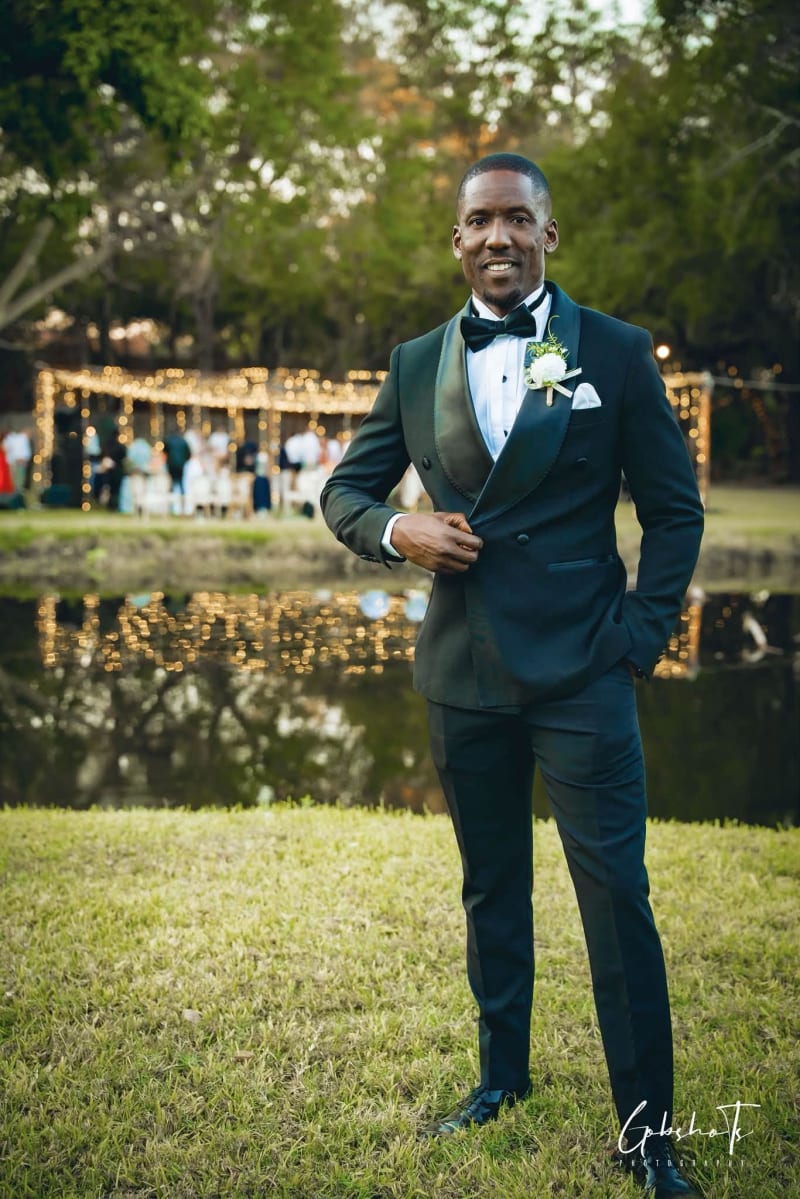
The second suit of the day. Behind him, the reception lit and waiting across the water. // Gobshots Photography
The voice Zambia already knows
If you follow Zambian media, you have heard this voice for years, whether or not you ever put a face to it.
K-Plus has been on air since 2007, starting on drive-time at YAR FM in Kitwe, on the Copperbelt. By 2009 he had the breakfast show. He moved to Flava FM in 2010 and held breakfast there until 2014. Between 2017 and 2019 he ran Beats FM in Solwezi as station manager. Then he did the thing broadcasters normally only talk about doing over drinks: he went and built his own station. Chete 89.9 FM, up in Nakonde, Muchinga Province, right on the Tanzanian border about as far from a Lusaka studio as you can get and still be transmitting.
In November 2021 he and Elson Chigerwe launched That Zed Podcast. It has since become the biggest podcast in the country by some distance the show where Macky 2 walks through an entire career, where Cleo Ice Queen sits down, where the guest chair rotates from rappers to bank chief executives to financial advisers with unpopular opinions about black tax. Chigerwe has publicly put the figures past eight million views and 300,000-plus followers on Facebook alone.
Alongside that: co-hosting the lifestyle show Uli Che on Zambezi Magic, and fronting corporate podcasts for ZANACO and Prudential. That last detail says more than any follower count. Banks and insurance companies do not hand their brand voice to an amateur.
That is the CV. It is not the job he was doing in Livingstone.
The job you cannot see
An MC is not a host. A host reads a room. An MC builds one.
Consider the actual degree of difficulty here.
You are the only person on that microphone. Almost nobody in front of you has ever met you. Nobody has heard your radio show. Nobody knows your podcast, your catchphrases, your timing, the small verbal shortcuts that let a familiar audience meet you halfway. Every unit of goodwill a well-known broadcaster gets to lean on gone. No home crowd. Your entire authority in that space has to be manufactured live, from nothing, inside the first ninety seconds.
Then you hold eighty people through speeches delivered in a language that is not the room's first language. You hear a toast running long before the person giving it does. You feel the exact moment the energy dips and you lift it before anyone in the room consciously registers that it dipped. You take a family that has just flown fourteen hours, fed them, toasted them, and somehow get them out of their chairs and onto a floor.
And you do every bit of it without ever becoming the story. Because the day belongs to two other people, and the whole craft is knowing that.
That is the work. It is invisible when it goes right, which is the only time anyone sees it at all.
Dressed for it
He also, it should be said, showed up.
Daytime: black shawl-lapel tuxedo, pleated shirt, cummerbund, patent shoes, sunglasses. Evening: a bottle-green double-breasted dinner jacket with satin lapels, white boutonnière at the buttonhole, pocket square folded sharp photographed standing beside a lagoon with the reception glowing gold through the trees behind him.
The suits came from Suit City Zambia, the Lusaka menswear house with counters at Levy Junction and Arcades. He credited them by name.
Zambian tailoring, on a Zambian MC, at an international wedding, photographed by a Zambian photographer, ten kilometres from a Zambian wonder of the world. Not one element of that day had to be imported.
How you know it worked
You never judge an MC by watching the MC. You judge by watching the room.
Early evening, the top table: glasses down, conversation stopped, everybody actually listening. That is a room being held — and holding a room is harder than filling one.
Later, it went. Jackets over chair backs. Shoes off and abandoned somewhere near the cake table. Arms up, heads back, phones out, the kind of noise that makes staff smile at each other across a service station. The chairs had stopped being for sitting on.
That is not a wedding that politely wound down at ten o'clock. That is a wedding that went.
And weddings go like that because somebody at the front made a long series of correct decisions about timing that nobody in the room will ever consciously remember making an impression on them. That is the entire trade, right there.
What it actually proves
The Zambian-born destination wedding planner Mwai Yeboah has written about spending a whole career answering one question from international couples: can Africa actually do this? Are the vendors there? Will the vision survive contact with the ground?
Here is one answer, and not a theoretical one.
A Belgian family put eighty of the people they love on aeroplanes on the strength of a promise about a place most of them had never seen. The florals held. The light held. The giraffes turned up. The room stayed standing until the shoes came off.
Nobody had to explain it to anyone afterwards. It simply worked.
The line on K-Plus's own page reads: Born in Zambia. Made for the world.
On the evidence of one July evening in Livingstone, the world is starting to book.
Photograph by Gobshots Photography, published by Kalenga "K-Plus" Chambatu. VersaEdits has not named the venue, the couple or their guests, who are private individuals. Rights enquiries: legal@versaedits.com
Are you a brand, artist or business who wants coverage like this? → partnerships@versaedits.com