This is the story of Sakana Fugu - what it is, where it came from, why it exists right now, and whether it actually does what it claims.
A Quick RunDown of What Got Shut Down, And Why It Affects You
Earlier this month, Anthropic, the American AI company behind the Claude family of models suspended global access to two of its most powerful systems, Claude Fable 5 and Claude Mythos 5. The directive came from the US government, citing national security concerns after researchers discovered a jailbreak... which is simply a method to bypass the safety guardrails built into the models that could unlock advanced cybersecurity capabilities in both.
The practical effect was immediate and blunt, anyone classified as a "foreign national" meaning anyone who is not an American citizen, regardless of where they live, work, or pay for a subscription, including Anthropic's own international employees lost access to both models overnight.
It did not matter if you were a paying customer. It did not matter if you had built products and services on top of these models. Access: gone.
This was not a hypothetical concern for developers and companies outside the US. It was a live demonstration of something the AI industry had avoided confronting directly. The most powerful AI tools on earth are controlled by a handful of American companies operating under American law. When that law moves, the rest of the world is collateral.
Enter Sakana AI
After some time of the Fable and Mythos shutdown, a Tokyo-based AI research company called Sakana AI announced it was launching what we think is its response.
Sakana AI is not a newcomer, and the people behind it are not amateurs. The company was founded by David Ha and Llion Jones.
Ha previously served as Head of Research at Google Brain's Tokyo lab, one of the most influential AI research divisions in the world. Jones carries an even more specific form of credibility: he is one of the eight co-authors of Attention Is All You Need, the 2017 research paper that introduced the Transformer architecture. If that name means nothing to you, here is what it means, virtually every large AI language model that exists today think of ChatGPT, Claude, Gemini, Grok, all of them... runs on the architecture that paper introduced. Jones helped design the foundation these models are built on.
Sakana AI is backed by Nvidia, Japanese megabanks, and Khosla Ventures. The company reached a valuation of approximately $1.5 billion in 2024. They previously made headlines with The AI Scientist, an autonomous system capable of generating and testing its own scientific hypotheses. These are serious researchers who have been building toward something specific for years.
The name "Sakana" means "fish" in Japanese. Their new model is called Fugu - the Japanese puffer fish, famous for being able to puff itself up to many times its resting size when threatened.
The timing and the name are not accidental.
Now, What Is Fugu, Actually?
Here is where most coverage gets lazy, so we are going to slow down because Fugu is fundamentally different from what most people imagine when they hear "a new AI model."
What standard AI models are: A single, massive neural network trained on enormous amounts of data. GPT-5.5, Gemini 2.5 Ultra, Claude Opus... these are each one very large model. One brain, trained once at enormous cost, running when you send it a question.
What Fugu is: An orchestration model. A different animal entirely.
Fugu is a smaller AI that has been trained not to answer your questions directly, but to decide which other AI models should answer them, send those models instructions, verify what they produce, and combine everything into a single coherent response. Think of it less as one brain and more as a conductor directing an orchestra, the conductor does not play every instrument, but the conductor determines which instruments play, when, and how their parts come together.
Inside Fugu, there is a pool of "agents" - different AI models, including instances of Fugu itself running inside itself recursively that the system can assign tasks to depending on what the problem requires. A complex coding challenge might get routed to a model optimized for code. A scientific analysis to another. A reasoning-heavy task to a third. Fugu coordinates all of that automatically and invisibly. You send one request to one endpoint. You get one answer back. What happens in between is Sakana's problem, not yours.
This approach is what Sakana calls collective intelligence. The core bet: a smart orchestrator of multiple good models can match or outperform a single massive model on demanding tasks and can do so without requiring hundreds of millions of dollars to train a frontier model from scratch.
Fugu comes in two versions. Fugu is the everyday model — lower latency, balanced performance, suited for regular coding work, chatbots, and interactive applications. Fugu Ultra is the flagship tuned for maximum quality on hard, multi-step problems like AI research, cybersecurity analysis, and patent investigations.
But Access is API-Only, What That Actually Means
This is thing people need to understand, Fugu is not a product you open in your browser and start chatting with, the way you would use ChatGPT or Claude.ai.
Fugu is API-only, well at least for now.
API stands for Application Programming Interface, an API is a connection point that lets one piece of software talk to another. When you go to a website and use an AI assistant, you're using a finished product that someone else built... the website, the interface, the experience. That finished product is itself calling an API underneath. An API-only model means the finished consumer product does not exist yet. You are getting the raw connection point, designed for developers and companies to build with.
To use Fugu directly today, you need to write code or work within a developer environment. Sakana uses the OpenAI-compatible API standard, which means if you have already built products using OpenAI's format, Fugu drops in with minimal rework.
That said, Sakana is also offering subscription tiers... Standard at $20/month, Pro at $100/month (10x the usage allowance), and Max at $200/month (20x) — suggesting consumer-facing applications are either being built or on their way. There is a promotion running through July 31, 2026: subscribe before then and your second month is free.
For non-developers reading this: note where it goes. If this model performs as advertised, developers will build interfaces on top of it quickly.
Does It Actually Match Fable? The Honest Assessment
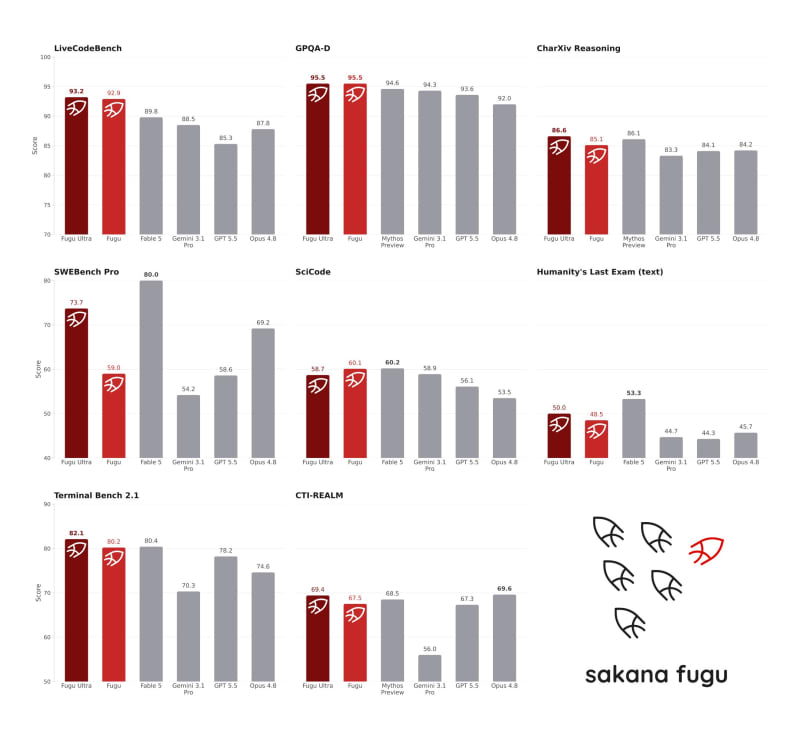
Sakana's benchmarks show Fugu Ultra performing at a competitive level with Fable 5 and Mythos Preview across engineering, scientific, and reasoning test suites. These are recognized, independent benchmarks — not numbers Sakana invented. That part is verifiable.
The honest nuance: Fugu achieves those benchmark scores through orchestration, meaning it is routing work to multiple models underneath, not running it through a single trained frontier model. Some of those models in the agent pool are not fully public. This raises a fair question — is Fugu Ultra a Fable-class model in its own right, or is it a smart routing layer coordinating access to other Fable-class models?
In practical terms, the answer may be: it does not matter. The output you receive from a Fugu Ultra call on a hard problem appears to match what Fable 5 would have produced. Whether it gets there through one brain or a coordinated team is an architectural question. The result is a results question.
500 beta users tested Fugu Ultra before launch, running it across data science workflows and full cybersecurity assessments. The reported finding: Fugu could sustain meaningful progress on complex, multi-step tasks with almost zero human intervention. That is the use case that matters for production.
The team is credible. The benchmark numbers are real. Real-world depth gets proven over months, not launch day — but this is a legitimate entry.
The Price
For API usage, Fugu Ultra runs at $5 per million input tokens and $30 per million output tokens at standard context length. Extend beyond 272,000 tokens of context and those rates climb to $10 input and $45 output. Cached input for repeated context that does not need to be processed fresh each call — sits at $0.50 per million standard, $1.00 extended.
This pricing is in line with what comparable frontier-class model access has cost across the industry. It is not cheap, but it is not out of line with what serious production workloads were already paying for Fable 5 access before the shutdown.
Lets take a step Back and look The Bigger Picture
This Is About Power, Not Performance
Sakana was explicit in their announcement. They described access to AI as a "material vulnerability" for any organization or nation relying on a single company's models for critical infrastructure. They named the shutdown of Fable and Mythos directly. They called their approach "the practical hedge against the concentration of AI power."
That is a geopolitical statement dressed up as a product launch.
Because Fugu orchestrates a pool of swappable agents rather than depending on any single model, a government cannot shut the whole system down by blocking one provider. Remove one agent from the pool, and Fugu routes around it. This is what Sakana means when they use the phrase AI sovereignty — the ability for an organization or country to maintain access to frontier AI capability without being subject to any one government's export control decisions.
It is a real concern. It just became demonstrably real two weeks ago. And Sakana moved first.
Whether the launch timing was planned around the Fable and Mythos shutdown or simply accelerated by it does not change the effect. Japan's most serious AI research company just launched a frontier-competitive AI system positioned explicitly as the alternative to US-controlled models.
That is not a coincidence. That is a strategy.
Sakana Fugu is real, it comes from a legitimate team, and it arrived at the precise moment the need for it became obvious to everyone watching.
The orchestration-over-monolith approach is genuinely novel as a commercial product strategy not just a research experiment and the benchmark performance numbers back up the claim, with the honest caveat that real-world depth takes months to prove at scale.
What is no longer theoretical is an era where one country controls global access to the most powerful AI tools just became significantly more complicated. Japan saw the opening, and they moved within hours.
The puffer fish is in the water.