Mark Zuckerberg’s Grand Return to X
Zuckerberg came back to Elon's app to sell his new model which is very different from the Llama models he previously released. This is after the open source Llama models fell behind. It is Meta’s big attempt to get back into the top-tier AI race.
You see the thing is Meta used to push Open Source models which are models you could download the weights and run them yourself. Some people even said Meta is the pioneer of Open Source though most disagree because of how China has done better when it comes to open source frontier models like Kimi 3 and GLM 5.2. By frontier I mean these are kind of models that are competing against the best from Open AI and Anthropic in certain BenchMarks.
Getting back to Meta so after losing the open source model competition against China Mark is now joining the Open AI, Google, Anthropic, and XAI in the closed models AI race with a model of his own he calls Muse. He created the Meta Superintelligence Labs in June 2025 and brought in Alexandr Wang, a young founder of Scale AI, the big data-labeling company as Chief AI Officer to lead it. Meta also put a huge amount of money into Scale AI as part of the deal ($14.3 billion for a 49% stake).
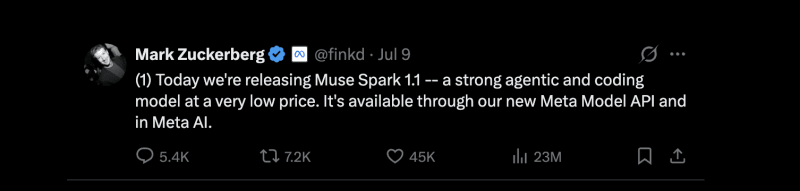
On July 9, 2026, Mark posted a thread not on Threads but X announcing Muse Spark 1.1. He followed up explaining its strengths: agentic performance, tool use, computer use, a 1-million-token context window, the ability to spin up parallel sub-agents, and training to control computer interfaces across desktop, mobile, or browser. The focus, he said, was delivering strong agentic and multimodal models at very low cost.
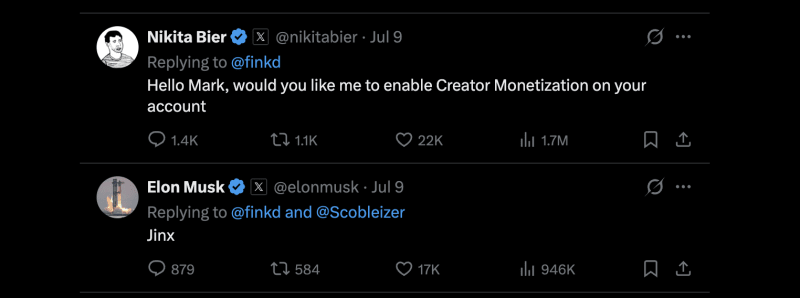
The tech world noticed immediately. Nikita Bier, then still closely tied to X product and later reflecting on his time as head of product, welcomed him with characteristic dryness: “Hello Mark, would you like me to enable Creator Monetization on your account.”
Elon Musk simply replied “Jinx” — a one-word post that drew laughs and speculation about timing, competition, or pure meme energy.
Elon meant the classic “jinx” game version the one where two people say (or do) the same thing at the same time and one calls “jinx.”
A week later Zuckerberg posted that Muse Spark 1.1 was now on OpenRouter after many requests. When a developer asked what separated it from the rest of the field, Zuckerberg replied simply: “High intelligence at a pretty aggressive price imo.”
That pricing stance has become a recurring theme.
Open weights, closed models, and the same page
Even while shipping closed models, Zuckerberg has kept the open-source conversation alive. When Microsoft CEO Satya Nadella posted about open-weight models being essential to a healthy ecosystem and American competitiveness, Zuckerberg quote-posted: “Open source is a positive and important force for both empowering people and preventing centralization. Proud to support this.” On this issue, at least, Meta, Microsoft, and others (including Elon at times) have found common ground.
Meta’s current strategy is clear: ship capable closed models that can be tightly integrated into Facebook, Instagram, WhatsApp, Ray-Ban glasses, and monetized through a real public API, while still signaling support for the broader open ecosystem.
So now, What exactly is Muse Spark?
Muse Spark is Meta’s new flagship AI model family. It is a proprietary closed multimodal reasoning model built by Meta Superintelligence Labs the new AI unit led by Alexandr Wang. Unlike the earlier open Llama models, you cannot download Muse Spark’s weights you use it only through Meta’s products or their paid API.
But looking at real developer reactions over the last month, here’s what people keep coming back to.
1. The pricing is the real moat
This is the thing that keeps surprising people.
Standard API: $1.25 input / $4.25 output per million tokens
Contributor tier: $0.10 input / $0.20 output (Meta can train on your data)
Multiple developers have called the contributor pricing “INDECENTLY CHEAP” or “Intelligence by the meter.” One person noted it’s cheaper than DeepSeek-v4-Flash while performing closer to GPT-5.5-class models. Another said Muse Spark 1.2 hit top 5 on the Vals Index at roughly $0.69 per test — 3x cheaper than Kimi and 10x+ cheaper than Opus / Fable / Sol-class models.
A lot of people are treating it as the “default cheap but still strong” model they throw at high-volume or long-running work.
2. It’s built for actual work, not just chatting
Users keep highlighting the agentic features more than pure intelligence scores:
Persistent background agents that stay alive the entire session (so they don’t lose context every time)
Ability to fan out parallel sub-agents into isolated worktrees (no collisions)
Full local event log — if it crashes, it resumes exactly where it left off
Comfortable running jobs that take minutes or even hours (one internal example was 24 hours and 1,000+ tool calls)
One developer put it simply:
“The part that caught my eye wasn’t even the benchmarks. It was the fact that Muse Spark 1.2 appears comfortable working through long engineering jobs that take minutes instead of seconds. That’s where real enterprise value gets created.”
3. Muse Code
Muse Code (the terminal agent powered by Spark 1.2) is what a lot of people are actually testing. Feedback so far:
Good at planning + writing + validating across large repos
Feels more “system-oriented” than just another coding model
Some users who were frustrated with Sol or Opus limits said they were “very pleasantly surprised” after switching for a few hours
Others treat it as an excellent fast/cheap sub-agent inside a larger agent harness rather than the single “god model”
But of Course there are Honest trade-offs people mention
Not always the absolute smartest model for complex creative tasks (some game-generation tests still preferred GPT-5.6 Soul or Qwen)
The ultra-cheap pricing comes with the data-sharing trade-off on the contributor tier
Still early, so the “vibe” and reliability are still being stress-tested by the community
The Llama era was about open weights and broad adoption. The Muse era, so far, is about personal superintelligence, aggressive efficiency, and agents that do real work. Whether that combination is enough to close the remaining gaps is the question the next few releases will answer. For now, Zuckerberg is posting on X again, the models are shipping, and Meta is once more a serious participant in the AI race.
Sources
8 independent sources · 6 corroborating reports · 2 further reading
Everything below is what this story is built on, so you can check it yourself rather than take our word for it.
Show all 16 sourcesOpen
- 1
Social post · Primary · X · @alexandr_wang
Post by Alexandr Wang
gemini who? 🏎️💨 https://t.co/5ANVqtBDkE
LiveCaptured 7 Aug 2026 - 2
Social post · Primary · X · @finkd
Post by Mark Zuckerberg
(1) Today we're releasing Muse Spark 1.1 -- a strong agentic and coding model at a very low price. It's available through our new Meta Model API and in Meta AI.
LiveCaptured 7 Aug 2026 - 3
Social post · Further reading · X · @nikitabier
Post by Nikita Bier
Hello Mark, would you like me to enable Creator Monetization on your account
LiveCaptured 7 Aug 2026 - 4
Social post · Further reading · X · @elonmusk
Post by Elon Musk
Jinx
LiveCaptured 7 Aug 2026 - 5
Social post · Primary · X · @finkd
Post by Mark Zuckerberg
A lot of people asked for this, so Muse Spark 1.1 is now on OpenRouter. https://t.co/TIsLHvlCsQ
LiveCaptured 7 Aug 2026 - 6
Social post · Primary · X · @finkd
Post by Mark Zuckerberg
High intelligence at a pretty aggressive price imo
LiveCaptured 7 Aug 2026 - 7
Social post · Primary · X · @finkd
Post by Mark Zuckerberg
Open source is a positive and important force for both empowering people and preventing centralization. Proud to support this. https://t.co/auQdR9Ms97
LiveCaptured 7 Aug 2026 - 8
Social post · Corroborating · X · @DaveThackeray
Post by Thack
The contributor costs of using @AIatMeta’s Muse Spark 1.2 are INDECENTLY CHEAP!Great model, too.Let’s cook!https://t.co/U1aicynDx7
LiveCaptured 7 Aug 2026 - 9
Social post · Primary · X · @prz_chojecki
Post by Przemek Chojecki | PC
I should have underlined how CHEAP running Muse Spark 1.2 is compared to similarly performing models like Kimi K3. And on top of that, if you allow Meta to use your data for training, it gets even more than 10x cheaper with $0.10 input and $0.20 output. Absolutely amazing.… https://t.co/AnkLEtYClR
LiveCaptured 7 Aug 2026 - 10
Social post · Independent · X · @ValsAI
Post by Vals AI
Muse Spark 1.2 just cracked the top 5 on the Vals Index, at just $0.69 per test. This is 3x cheaper than Kimi and 10x or more cheaper than Fable, Opus, and 5.6 Sol. pic.twitter.com/E2pFFqQiBI
LiveCaptured 7 Aug 2026 - 11
Social post · Primary · X · @plumberbutt97
Post by former plumber, current ai fan
The part that caught my eye wasn’t even the benchmarks.It was the fact that Muse Spark 1.2 appears comfortable working through long engineering jobs that take minutes instead of seconds.That’s where real enterprise value gets created.
LiveCaptured 7 Aug 2026 - 12
Social post · Primary · X · @finkd
Post by Mark Zuckerberg
Releasing Muse Code in beta today. It's a terminal coding agent that takes on complete software engineering tasks across large repos: planning changes, writing code, validating the results. Powered by Muse Spark 1.2, a coding-focused model update. pic.twitter.com/xqavk41w6v
LiveCaptured 7 Aug 2026 - 13
Social post · Primary · X · @SFourdrinier
Post by Stephane
I feel strange saying this…. But. Because if frustration with Sol - slow and hitting limits, and Opus 5. I gave a chance to Muse Spark 1.2 the last 3 hours. With muse code.I’ve been very pleasantly surprised. Now I wish there is a coding plan.
LiveCaptured 7 Aug 2026 - 14
Published article · Independent · AP News
Meta invests $14.3B in AI firm Scale and recruits its CEO for 'superintelligence' team
LivePosted 13 Jun 2025Captured 7 Aug 2026 - 15
Published article · Independent · CNBC
Mark Zuckerberg announces creation of Meta Superintelligence Labs. Read the memo
LiveCaptured 7 Aug 2026 - 16
Published article · Independent · VentureBeat
Meta enters the AI coding wars with Muse Spark 1.2 and Muse Code
The standard tier is priced at $1.25 per million input tokens and $4.25 per million output tokens (with cached input at $0.15), and Meta commits that prompts and completions on this tier are not used to train its models.
Rate-limited when checked automatically (429). Page opened and read directly on 6 Aug 2026; the pricing sentence above is verbatim from it.
LiveCaptured 7 Aug 2026
Something here wrong or missing? versacorp@versaedits.com